Monday, July 9, 2012

Exercise of the Week-Calve Stretch


Variation 1
Difficulty: Easy
(Consult your chiropractor before doing this or any other exercise.)
Start: Standing behind a chair or in front of a wall. Place hands on
backrest or wall for balance.


Exercise: Bring one foot behind as far as possible, keeping heel
on floor and knee straight.
You should feel tension behind lower leg, close to knee.
Lean hips toward chair or wall to increase lengthening effect.
Hold for 30-60 seconds, relaxing muscles of lower leg. Switch
sides, and repeat 2X per side.

Monday, July 2, 2012

CHIROPRACTIC FROM HEAD TO TOE – SHOULDER PAIN


How can chiropractic help with my shoulder pain?

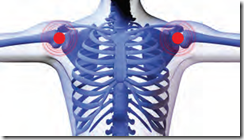
The shoulder is a very unique and complex joint. It is the only articulation in the body whose stability is granted primarily by muscular balance instead of being held together by the
integrity of its ligaments. Have you ever heard of the ROTATOR CUFF? This is the collection of four shoulder muscles that help perform this function: namely the supraspinatus, the infraspinatus, the teres minor and subscapularis.

In addition, there are multiple bones that come together to make up the shoulder joint: the humerus (upper arm), the scapula (the shoulder blade) and the clavicle (the collar bone).
Therefore, problems with the alignment of any of these bones will directly affect shoulder function, potentially leading to dysfunction and painful symptoms in this joint.
image

Finally, many nerves lead to the shoulder, influencing motor control of the shoulder and providing sensory feedback from the shoulder to the brain. The main source of these nerves is the cervical spine (the neck). So, how can your chiropractor help when you have a shoulder problem?
Just like every other joint in the body, the shoulder works best when all its moving parts are in proper alignment.
As you will discover below, the most important factor contributing to the proper function of the shoulder is the alignment of your spine, with each major area of the spine contributing in a significant way to the health of your
shoulder.

First and foremost, since nerves connected directly to the shoulder originate in your neck, the cervical spine is the first area your chiropractor will check when you have pain in your
shoulder. Vertebral subluxations in your cervical spine can cause impingement or irritation of joints, nerves and soft tissues. If the subluxation in your neck is irritating a nerve, you may experience motor (muscle) or sensory (skin) deficits related to this subluxation.
Your chiropractor can test the integrity of your shoulder muscles to see if a muscle weakness correlates to the same vertebra level as the subluxation in the neck or, your chiropractor may notice that your pain patterns follow the specific pathway that mirrors the dermatome of a sensory nerve from your neck. If either or both of these are present, a cervical subluxation is likely the cause of your shoulder problem.

Second, since your shoulder blades rest on the ribcage, alignment of the thoracic spine and the ribs are also influential for proper shoulder function.
One of the most common causes of shoulder impingement is poor posture, which in turn may be caused by upper back misalignment. When the upper back is too rounded, for example,
shoulder blade position is altered and the shoulder joint will shift forward. If this ‘slumped’ posture exists, over time this may contribute to muscle imbalance around the shoulder, leading to
stress and strain. Rotator cuff strain is a common complaint related to poor posture in this area. Thoracic subluxations can be both the cause, and the effect, of this problem.

Third, although it may seem unlikely, alignment of the lumbar spine is also important when it comes to shoulder health. Why? For two main reasons:
1) the lower back curve sets the posture of the rest of the spine. If the lumbar spine is curved too much or too little, the thoracic and cervical curves will be directly affected, which in turn can affect the shoulder;

2) one of the larger muscles of the upper torso, the latissimus
dorsi, connects to the arm near the shoulder and then at its other end to the lower back and pelvis through the thoracolumbar fascia. Therefore, lower back alignment can affect the function
of the shoulder, and vice-versa.
With a spine free of subluxations, your shoulders have the best chance to move properly, be positioned properly, and, as a result, to be pain-free. Chiropractic adjustments, aimed at removing vertebral subluxations from all areas of your spine, are one of the most effective tools you can use to keep the stress and strain away from your shoulders.
So, the next time you feel the weight of the world on your shoulders, call on your chiropractor to lighten the load!image

Monday, June 18, 2012

How Does Breakfast Impact Your Health?


You have no doubt heard the old saying “Breakfast is the most important meal of the day,” but aside from providing calories for energy, what are the other benefits of eating a morning
meal? Research conducted on breakfast in the last decade shows how it may affect obesity, cravings, and nutrient intake. Breakfast also appears to influence the type of foods we select
to consume during the rest of the day.image

What Science Says

According to a 2011 survey about 10 to 12 percent of people in North America skip eating breakfast. Breakfast research has focused on a number of questions, including…
• Can breakfast lower your risk of
disease?
• Do breakfast eaters snack less than
breakfast skippers?
• Does eating breakfast help control
body weight?
A study conducted in France showed people who consumed one quarter of their daily calories at breakfast were more likely to skip fatty food items and boost their levels of vitamins and
minerals compared to breakfast skippers. As well, the authors commented that “…breakfasts and cereal consumption were associated with lower serum cholesterols” in the breakfast eating group.
An advantage of eating a breakfast cereal rich in fiber is it lessens the risk of heart disease. Soluble fiber reduces the absorption of cholesterol into your bloodstream, and makes you feel fuller longer, so you often cut your overall daily calorie count. Breakfast cereals made from whole grains is a great way
to increase your fiber intake, which should be about 1 ounce (25 to 30 grams) each day. Studies show that people who reach these levels of fiber intake slashed their risk of heart attack
from 25 to 35 percent.

A similar study, published in the Archives of Internal Medicine, revealed people who regularly ate whole grain breakfast cereals had a lower risk of heart failure.
As well as fiber, one study showed that eating sufficient protein at breakfast can help you feel full. Research conducted at the University of Missouri used MRI scans on human test subjects,
and the scans revealed a protein focused breakfast reduced brain signals controlling food “motivation and reward-driven eating behavior.” A protein heavy breakfast may curb snacking and assist people in losing weight more easily.
The medical journal Pediatrics conducted a study on adolescents and discovered over a five-year period teens that consumed a daily morning meal were more likely to eat healthier, be more physically active, and have a lower body mass index (BMI) than teens that skipped breakfast.
Another adolescent study was initiated “to examine the association of breakfast and cereal intake with body mass index (BMI) and consumption of nutrients” by girls.  The researchers found that girls regularly eating cereal was “related to increased intake of fiber, calcium, iron, folic acid, vitamin C, and zinc, and decreased intake of fat and cholesterol…eating cereal was predictive of lower BMI.”

“Would You Like to See the Dessert Menu?”

image
One of the most surprising breakfast studies came out earlier this year.
Researchers in Israel found that having dessert after a well-balanced 600 calorie breakfast of protein and carbohydrates
actually helped dieters to lose weight and keep those extra pounds
from returning. The study published in the medical journal Steroids followed obese participants for 32 weeks and discovered that those people who added a dessert (cookies, cake or
chocolate) lost an average of 40 lbs (18 kilograms) compared to the participants who did not include sweets. What can explain this unusual result? The lead researcher noted that avoiding
sweets completely can actually make psychological cravings stronger.
Restrictive diets work initially, but as times goes by many dieters become weary of the depravation and return to snacking on sweets throughout the day.
A researcher commented: "…the group that consumed a bigger breakfast, including dessert, experienced few if any cravings for these foods later in the day."
* * *
When it comes to eating a well rounded breakfast, you should include servings of whole grain, fruit or vegetables and a healthy source of protein. These choices will help deliver the energy to start your day, keep you feeling fuller longer, and prevent unhealthy snacking. Have questions about your diet? Ask your
chiropractor!

Friday, June 15, 2012

Exercise of the Week

Lateral Flexion + Forward Flexion


Difficulty: Easy to moderate
(Consult your chiropractor before doing this or any other exercise.)

Start: Sit upright in chair.

min
Exercise: Place one hand on top of head, with fingers pointing
down toward opposite shoulder, behind ear (image 2). Then, allow
neck to relax as weight of arm pulls head and neck gently forward and to opposite side (image 3). Chin should be pointing down toward knee, and you should not feel pain in this position. Drop shoulder on side you feel the stretch. Hold for 20-30 seconds. Switch sides, and
repeat 2X per side.

Monday, June 11, 2012

Chiropractic From Head to Toe: Upper Back Pain

Although injuries to the upper back (thoracic spine) are not as common as lower back or neck injuries, there are still a number of conditions and factors that can contribute to pain and discomfort
in this area. Thankfully, your chiropractor knows how to ease your pain!
The thoracic spine is that area of your back where the ribs are attached—also called your upper back. Because of its location, the upper back and ribcage are designed to be more stable, creating a protective “cage” for many of your vital organs—like the heart, lungs, liver, stomach and spleen. Since the thoracic vertebrae do not have the same range of motion as the cervical or lumbar vertebrae, it is rare for someone to experience a disc herniation in this area.1 In fact, only about 1-3% of all disc herniations occur in the thoracic spine. Even when present, thoracic disc herniations do not necessarily cause symptoms in the person who has them! So, what causes upper
back pain?
Most of the pain felt in this region is caused by muscle and/or facet joint irritation. Many very important postural muscles are found in the upper back and will attach to the vertebrae in this area. Notably are the muscles that control shoulder stability—like the rhomboids and trapezius muscles. In addition, the postural muscles that support the head and neck in a vertical position will find their anchor points in the thoracic spine. These muscles are
collectively known as the erector spinae.
Whenever a person’s posture deviates away from the center of gravity, such as when the head is held forward or the shoulders rounded (two of the most common postural faults), this will put a large compressive load on the joints
between each vertebra (the facet joints), leaving them prone to feeling the stress and strain. Also, any minor spinal misalignments (subluxations) begin to feel like major ones when
there is any abnormal muscle tension in the area! Pain sensitive structures like joint capsules, ligaments and neighboring nerves can all be irritated by this phenomenon.

In addition, where each rib attaches to  the spine, there is a set of 3 joints  collectively called the costovertebral  joints. Since these are functionally  movable joints like any other in the  body, this means they are also subject  to the same stress and strain that other  joints experience and they can also  subluxate when put under an abnormally  high or sudden load. You’ve  heard the expression, “I have a rib  out”? This can be a very painful  condition where you feel a sharp,  stabbing pain on either side of the  spine. It may be difficult or painful to  take a deep breath, and laying on your  back with pressure directly on this area  may also be painful.
No matter whether the joint that is  irritated belongs to the vertebra or the  rib, your chiropractor knows exactly  what to do to set things right. You  guessed it—the chiropractic adjustment!
With the application of this  skilled and precise maneuver, the  irritated joint can be re-aligned to sit  properly, taking the pressure off the  sensitive structures that surround the  joint (capsule, ligament or nerve).
Regardless of which joint it is, once  freed from restriction and misalignment,  the physiological cascade called  “healing” can begin: sometimes the  relief from pain is immediate and  dramatic; other times it takes a few  days for the positive effects of the  adjustment to kick in. However, rest  assured the adjustment always initiates  healing.  When the vertebral subluxation is  reduced, muscle tension around the  joint will also be improved.

image

However, sometimes extra procedures  should be specifically applied to  the muscles to create ease and balance  in the muscular system. Massage  techniques that focus on tight muscles
in the area of symptoms have also been  shown to reduce pain,4 enhancing the  already positive effects granted by the  chiropractic adjustment.
Finally, if the stress and strain on the  upper back is caused by weak postural  muscles, exercising and stretching will  also be recommended as an effective  tool to support your proper spinal
alignment long-term.5 Many chiropractors  are well-versed in the protocols of  posture correction and others rely on  allied professionals to help instruct  their patients in these areas. Discuss  what your best options are with your  chiropractor.
With chiropractic adjustments and  advice, upper back pain can be lifted  from your shoulders.

Friday, June 8, 2012

Exercise of the Week


Range of Motion: Rotation


Difficulty: Easy
(Consult your chiropractor before doing this or any other exercise.)


Start: Sit upright in chair.image


Exercise: Turn head as far to one side as you can. Stop when you
feel resistance to movement, but no pain. Hold for 10-15 seconds.image


Then, turn head as far to other side as you can. image

Once again, stop when you feel resistance, but no
pain. Hold for 10-15 seconds.
Repeat 5-10X per side.

Monday, June 4, 2012

Attention Deficit Hyperactivity Disorder


(ADHD) is the most common neurological disorder among children, accounting for over 35% of all medical referrals to psychiatric clinics. In North America, it affects about six
million kids and the rate appears to be increasing, as statistics showed a 22 percent jump in ADHD cases from 2003 to 2007.1 Although a few medical researchers believe it may be over diagnosed and over treated, ADHD remains a challenging disorder for both children and their families.
Kids with ADHD have trouble concentrating, act impulsively and have difficulty remaining still. It can dramatically impact their academic performance and social status among peers.
For reasons that are still undetermined, boys are more likely to be
diagnosed with this disorder, and are prescribed medication three times more often than girls. Recent studies also indicate ADHD may have a pivotal role in the development of other chronic health conditions. For example, insomnia and other sleep disturbance problems appear more often in children with ADHD.
A study published in the journal Sleep showed 17 percent of ADHD adolescents suffered insomnia compared
to 7 percent of teens without this disorder and the research indicates these sleep problems may extend into adulthood.2 Lack of sleep also exacerbates attention and concentration problems.
No cure for ADHD exists, although it can be managed with the assistance of qualified healthcare and education professionals. Current treatment methods may include behavioral therapy and/or medication. The exact cause of ADHD remains unclear, but genetics, diet and environment may influence the emergence of this disorder.

ADHD & Nutrition


Many parents of ADHD children are looking for an alternative– or a reduction – to medication. Changing to a healthier diet may reduce symptoms for some kids.
Medical research points to Western society’s indulgence of processed food, often high in refined sugar and low in nutrients as a possible cause of ADHD.
Food additives and coloring are also suspects. Research published in the Journal of Attention Disorders reveals the common Western diet doubled the risk for developing ADHD. This may be the result of the low levels of nutrients in this food.3
Some experts also recommend testing ADHD kids for gluten intolerance and, if they test positive, removing gluten food products from their diet.
Switching ADHD children to a diet rich in fruits, vegetables and fish may provide a way to reduce the symptoms.
Research indicates omega 3 fatty acids found in fish are excellent for optimizing the health of the brain and nervous system. In particular, DHA, or docosahexaenoic acid, seems especially influential on proper brain function for memory and learning. Choose fish that have low mercury levels, such as anchovies, mackerel and wild salmon. While more research needs to be conducted on this subject, a study that appeared in the American Journal of Clinical Nutrition noted that ADHD “subjects with lower compositions of total n-3 fatty acids had significantly more behavioral problems, temper tantrums, and learning, health, and sleep problems than did those with high proportions of n-3 fatty acids.”

image

Missing Minerals May Make Impact


A mineral that may be important for reducing ADHD symptoms is magnesium. It is involved in hundreds of chemical reactions in the body. Unfortunately, magnesium deficiency is common in the Western world. When you have low levels of the mineral, your nervous system can become agitated and overexcited.
A French study on ADHD children revealed those that received a combination of magnesium and vitamin B6 over eight weeks achieved substantial improvement in attention and other cognitive functions. When they no longer received this nutritional combination, the children’s ADHD symptoms
returned.
Another mineral that may help with ADHD is zinc. The Journal of Child Psychology and Psychiatry revealed that zinc levels of ADHD kids were 43 percent lower than children in the
placebo group.
* * *
It is preferable to have your child get required nutrients through his or her diet. If your child is a finicky eater, supplements may fill the nutritional gap -- consuming a good quality multivitamin may help ADHD kids achieve optimal nutritional levels. However,
you should always consult your chiropractor or pediatrician before providing your child with vitamins, herbs or other
supplements.